BUYER'S GUIDE
How to choose an eTMF system
A practical guide for clinical teams
.avif)
A practical guide for clinical teams
An Electronic Trial Master File is a specialized content management system used to manage clinical documents across the life cycle of a clinical trial.
eTMF systems help you maintain compliance with regulatory agencies. They also give you a historical record of the events that took place over the course of a clinical trial.
Regulatory documents used to be paper-based, stored centrally in physical file cabinets. Electronic systems changed that, and eTMF systems now have widespread adoption across the industry.
No two eTMF systems are identical. The features below are grouped into seven functional categories. Within each, basic features cover what every eTMF should do. Advanced features show what separates a mature system from a basic one.

This category has no basic tier. Risk-based oversight is what ICH E6(R3) now expects, and it's a mark of a mature system rather than an entry-level one.
This category has no basic tier. These capabilities either exist in a mature form or don't exist at all, which makes them a strong differentiator when comparing vendors. It splits into two distinct needs: connecting to your broader clinical operations stack, and automating document exchange with external parties.
This category also has no basic tier, for the same reason as Integration and Exchange.

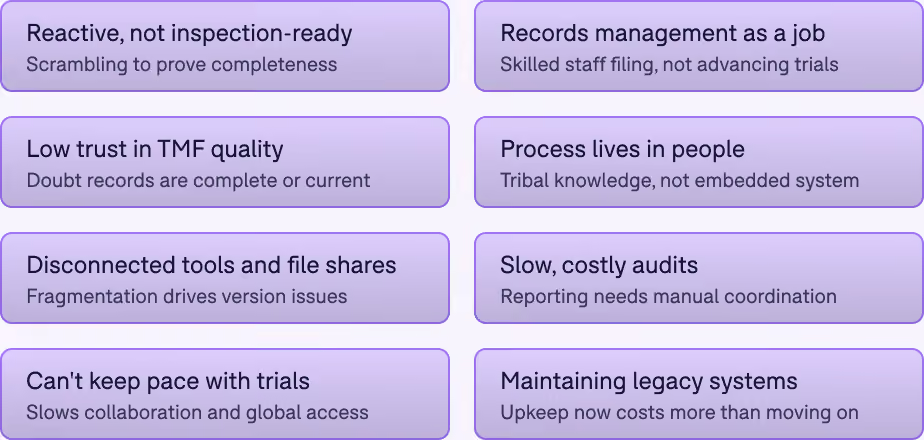
Most teams don’t wake up one day and decide to replace their TMF. It’s usually a slow realization—friction builds, risks increase, and what once “worked fine” starts holding the organization back. If any of the following sound familiar, it’s a strong signal your current TMF approach isn’t keeping up:

Everyone wants the tool that will solve every problem quickly. Before selecting an eTMF system, and ultimately an eTMF vendor, it's important to understand the full picture of your organization and your top priorities.
Look at the individual needs of your stakeholders, the processes you have in place, and your budget. Once you've done that, you're ready to evaluate the options on the market today.
To get started, here are some prep questions to work through with the team:
Making the decision to select new software for your organization is no small task. While it's easy to get excited about the potential benefits a new software could bring, selecting software systems without the proper planning, and defined criteria for evaluating and selecting a system, can lead to oversights and bad investments. This section will outline some key steps and important advice when you are looking to implement an eTMF at your organization.
Prior to even looking at available eTMF system options, make sure you thoroughly define your needs and requirements. Life sciences organizations for the most part are process-driven, they receive vast amounts of information and content on a daily basis, and are responsible for complex business processes that have ethical considerations as well as regulatory requirements.
Technology can facilitate the way your organization manages these processes, but it doesn't take your requirements and needs into account on its own. This is why defining your requirements is a critical step.
Defining your requirements begins by assembling a vendor selection team. Their responsibility is selecting the right eTMF system for your organization.
Select individuals who have a shared interest in the vendor selection process, along with expertise and understanding of the area of the business the software will support.
There are numerous ways to prepare these requirements, such as use cases. Just remember, the goal at this stage is to be able to clearly communicate your needs to the potential vendors, and have a baseline to evaluate the options that will present themselves.
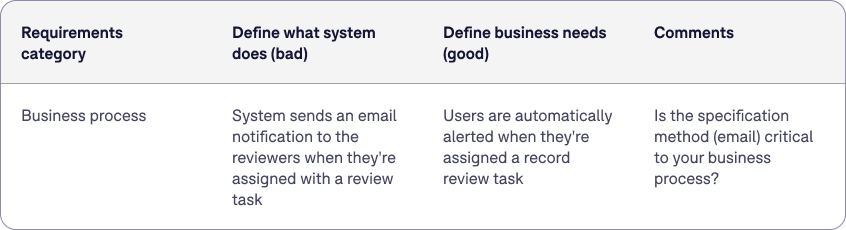
Don't aim to produce a detailed system requirements specification for a development team at this stage. The most common mistake at this step is designing the system instead of defining the business needs. Write requirements with your users in mind.
Below is an example of how you can write clear vendor requirements. You should stay business-focused, keeping away from system design:
The first task of the vendor selection team is to review the high-level features needed for the eTMF system, and to produce a set of requirements by gathering additional information from stakeholders.
Keep your list simple. Don't worry about formally categorizing requirements as functional versus non-functional. That structure belongs in validation, later.
What matters now is capturing the full picture: what the system needs to do, and everything around it.
Things like availability, security, backup and disaster recovery, and data export at contract end are better handled as questions you ask the vendor and terms you negotiate, not requirements you write. Ask for the evidence: SOC 2 or equivalent, DR test results, exit and portability terms. Get the commitments into the contract or terms and conditions.
A large list of detailed requirements works against you. You'll forgo solutions that would have met your business needs because they didn't fit the requirements filter you created upfront. A long, detailed list slows down the vendor selection process and limits your options.
If most out-of-the-box solutions don't meet your specific business needs, that's when custom development becomes worth considering, and that's when complete system specifications make sense, not before.
Requirements can include anything related to the product offering you're hoping to implement, well beyond functional and non-functional system requirements. Consider services (deployment, validation, migration, training, general support), supporting documentation (procedural templates, validation documents, training materials), and organizational characteristics (quality maturity level, industry expertise, geographical location).
With a complete list of requirements on hand, you will need to assign the level of importance that each requirement carries. This can be done on a 1-2-3 scale: 1. Nice to Have, 2. Important, and 3. Critical to Operations.
Keep this determination to yourself. Don't communicate it to the vendor during the RFI (Request for Information) process, but have it determined before moving to the next step.
Two organizations evaluating the exact same eTMF vendor can end up with completely different requirements, because their starting point and their growth trajectory are different. Before you build your requirements list, it's worth being honest about both.
Your requirements should account for where you'll be in two to three years, not just where you are today.
A larger, established organization has usually already worked through these questions. A stable organization can often make do with what fits today. A growing organization is the one that feels the mismatch fastest, since headcount, trial volume, and complexity are all moving targets at once.
The temptation is to buy for today's needs, since it's simpler and cheaper in the short term. But an eTMF system isn't something you swap out casually once it's embedded in your process. Treat growth-path fit as its own requirements category, not an afterthought to features and price.
Although we recommend staying away from detailed system specifications, we still suggest you develop a list of clear and verifiable requirements. Below are some categories worth considering as you define your future paperless system.
Selecting the right technology vendor ranks among the most important decisions a clinical or IT leader makes this year. The search takes work. Take the time to find a fit on both a technological and a human level.

This chapter walks through the next phase of eTMF vendor selection: how to research vendors and move through your evaluation with confidence.
With your requirements defined, start researching vendors and gathering information. The market offers no shortage of vendors and solutions, but not every vendor meets your minimum requirements. Your team will need to decide together how to score and rate each vendor and product as you move through selection.
When you first reach out to vendors, ask specific questions to evaluate how relevant their products and services are to your project.
This stage is not a formal information-gathering process. Developing a set of high-level questions helps you classify vendors early and saves time once you launch a formal request-for-information (RFI) process.
Consider these questions as you sort through vendors and build your initial shortlist:
Once you develop a list of potential vendors, identify which ones should receive a formal request for more detail. An RFI process, starting with an RFI document, works best for this.
The RFI document lets you request specific information from vendors in a standard format, so you evaluate every vendor against the same criteria.
Sending your RFI to twenty vendors slows the process down and makes final selection harder. When Montrium works on vendor selection with clients, we limit RFI distribution to four or five vendors. Once you confirm your shortlist, send the RFI documents and start assembling the responses as they come back.
With requirements defined, demonstrations attended, and proposals in hand, start evaluating what you have gathered from your shortlisted vendors.
The goal: minimize emotion and reach a decision that fits your organization.
Seek input from your vendor selection team and from management before you finalize a decision. Once all RFIs are back, begin evaluating responses and assigning a numerical value to each. Build a scoring system first, before you start scoring vendors.

Start with an evaluation sheet based on your RFI criteria. The approach below adapts a weighted scoring methodology from Vendorfi. List your criteria, assign each one a weight reflecting its importance, then score each vendor's response on a consistent scale. Multiply score by weight for each criterion, then sum the results for a vendor's total score.
Be specific. Instead of "good support," name what you're evaluating: response time commitments, dedicated account management, or availability of a named support contact.
Distribute 100% across your criteria based on what matters most to your organization. A team preparing for imminent inspection might weight compliance and audit-readiness features heavily. A team scaling fast might weight implementation speed and user-based pricing instead. There's no universal weighting. Your priorities should drive the split.
Use a defined scale, 1 to 5 works well, and write down what each number means before you start scoring. Without that, one evaluator's "3" is another's "4," and the matrix stops being objective.
Multiply each score by its weight, sum the results, and compare vendors on total score. The example below shows how this plays out for an eTMF evaluation, weighted toward compliance and oversight:

Vendor A scores well on ease of use and implementation speed, but Vendor B wins on total score, because compliance and oversight carry the heaviest weight in this matrix. That's the point of weighting: it keeps a strong showing in a low-priority category from masking a weak showing in a critical one.
Don't list more than eight to ten criteria. Beyond that, the weighting loses its power to differentiate, and the exercise becomes unwieldy. Numbers alone don't capture everything either. If a vendor scores well but the working relationship feels wrong in early conversations, that's worth weighing alongside the matrix, not ignoring in favor of it.
Follow these steps to narrow your shortlist and determine the winning vendor:
Once your evaluation sheet is complete, build a shortlist based on scoring, then move to the final round: picking your vendor.
The final stage of vendor selection: developing a contract negotiation strategy. Approach this stage as a partnership, not a transaction.
Prepare for negotiations by covering the following:
A vendor maintains standard terms for a reason. Consistent contracts let them manage support, updates, and compliance obligations across every customer they serve. Before you push for exceptions, understand which terms are genuinely negotiable and which reflect real constraints on their side.
Cultural fit matters as much as product fit. Selecting a strong product solves one part of the equation. Choosing a vendor willing to invest in the relationship, and one that understands your business, sets up a partnership built to last. Focus on mutual benefit from the start, since this relationship extends well past implementation.
As you plan your transition to an eTMF, the budget question comes up fast: how much will this cost. Budgeting ranks among the most critical parts of any organizational change, and understanding every variable is critical to getting it right.
Use the requirements and features list you built in the previous chapter to guide your budget planning. Since you already categorized these by importance, prioritizing becomes easier. Sit with your key stakeholders and the people who will use the eTMF daily to understand what they need to succeed. Capture these needs, then survey leading eTMF vendors to see who provides these features and what they charge.
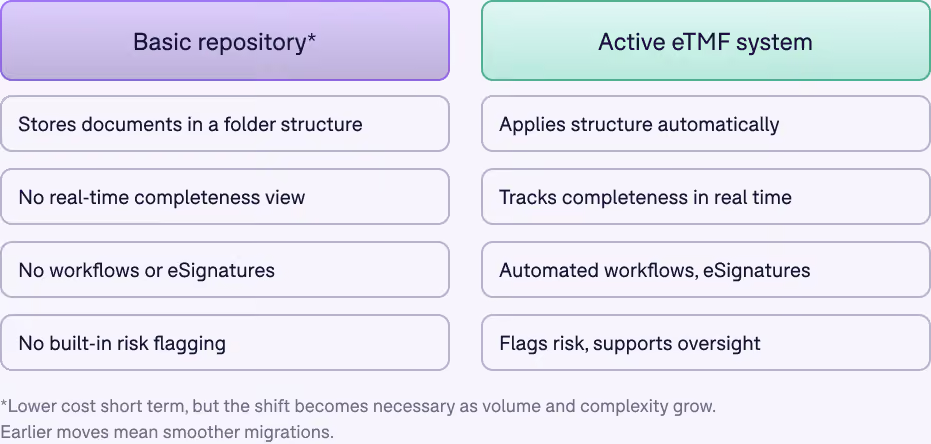
A basic repository stores records. An active eTMF system does more. It applies structure automatically, tracks completeness in real time, flags risk, and supports the oversight regulators now expect. If you need automated tasks, workflows, electronic signatures, risk-based oversight, or built-in business intelligence, a basic file share will not deliver them.
A small organization with limited funds may start with a basic repository, storing documents in a defined structure. These systems have a shelf life. As your team and business grow, a basic repository becomes too limited to support your needs.
As you evaluate functionality, distinguish between a basic content repository, like OneDrive or Office 365, and an active eTMF system.
A basic repository saves money in the short term, but the transition to an active eTMF system eventually becomes necessary, and that transition means migrating content and information. Organizations that make the shift early, before volume and complexity force the issue, see the smoothest transition.
Cloud is the default for eTMF systems today. But not all cloud is the same, and the differences affect both your budget and your risk exposure.
Ask whether the environment is multi-tenant, where your data shares infrastructure with other customers in a logically separated environment, or single-tenant, where you get a dedicated environment. Ask how tenants are segregated, and what that means for your data in practice.
Ask where your data physically resides. Global trials often need documents stored in specific regions for legal or regulatory reasons, so confirm the vendor can meet your requirements before you sign.
Ask whether encryption keys are unique to your organization or shared across the vendor's customer base. This affects how isolated your data really is, beyond the tenancy model alone.
Get the vendor's availability commitment in writing, along with RPO (Recovery Point Objective) and RTO (Recovery Time Objective) figures. Ask for DR test evidence, not just a stated policy. A vendor that has actually tested their disaster recovery process can show you results, not only a plan.
Ask what happens to your content at contract end. Confirm export formats, how long your data stays accessible after termination, and whether full audit trails and metadata export alongside the documents themselves.
Understand how each pricing model scales. A per-user fee lets you scale up and down as operations shift. Other models make that harder.
Cloud models scale your IT budget more economically by nature. Whether you choose a dedicated cloud environment or a multi-tenant SaaS service, you will pay to set up the environment, validate it, and train your team. For SaaS, upfront costs run a fraction of an on-premise setup, since the vendor handles most of the technical maintenance.
eTMF SaaS subscriptions are typically priced per named seat, though some vendors charge per study or per site. Evaluate which model fits your business and choose vendors accordingly.
Cloud vendors take on most of the responsibility for managing the underlying technology, but your team still needs to stay involved during setup and onboarding to ensure the system gets configured and adopted correctly. The time investment runs far below an on-premise project, and your commitment during this phase sets up the system for long-term success.
Cloud eTMF pricing works differently from on-premise licensing. Rather than paying upfront for a license plus separate implementation, validation, and support costs, cloud vendors typically charge an initial setup fee, then bill system maintenance, support, and access as a predictable fee, monthly, annually, or per subscription term.
This structure offers two practical benefits. First, it spreads the cost of an enterprise-grade system over a longer period instead of requiring a large upfront outlay. Second, it reduces budget creep, since setup and onboarding costs are fixed rather than estimated.
Subscriptions typically include upgrades, so your team always has access to the latest version of the vendor's eTMF software as regulation and technology evolve, without a separate upgrade fee. Depending on your risk-based validation approach, your team may still choose to validate new features at each upgrade, which requires internal resource time.
When you request pricing for a cloud eTMF system, ask for a clear breakdown of what is bundled into the fee versus billed separately, and how much of your budget is required upfront versus over time.
Electronic Trial Master File systems now rank among the fundamental pieces of a well-run clinical program. Not everyone sees this the same way. Finance teams sometimes view an eTMF as an added expense rather than a smart investment.
Preparing a proposal for budget approval presents a challenge, and the challenge grows when your finance team lacks context on your team's needs, pains, and goals. Here are a few strategies for easing that process and winning approval for an eTMF system.
Getting finance on board comes easier when your pitch aligns with their priorities. Research your CFO's and finance team's strategies and goals for the coming year. These goals might include improving cross-functional efficiency, automating current processes, or increasing data security. Once you understand their goals, show how an eTMF system moves them closer to achieving those goals.
Finance teams work toward many high-level goals. Align your pitch with those goals and frame it accordingly, and approval gets easier.
Timing matters as much as alignment. Track the time of year financial planning happens and when budgets get decided. Present your case well before budgets are finalized. Too early, and your case may not register as a priority. Too late, and the budget is already allocated.
If your finance team lacks context, explain why an eTMF matters and what problems you are solving. TMF professionals live and breathe this work daily, and it's easy to forget that others don't share that depth of context.
Start by checking whether your finance team knows what a Trial Master File is. If not, explain it, and explain why proper management of records and data matters to the organization. These records can face inspection at any point, and they matter directly to the success of your clinical trials. Once your finance team understands this, walk through the pain points of your current process and how an eTMF addresses them.
If you work with paper, how do you share records with stakeholders across the globe? How does collaboration happen? How long does it take to retrieve a single record from a room full of paper files? These questions build your case. Paper-only processes mean no metadata, no traceability, no oversight, and limited accountability. Once your finance team grasps the depth of these issues, they grow more willing to help solve them.
Cost dominates most conversations about software. Shift the conversation to investment instead. What return will you see? For a full breakdown of licensing, implementation, and infrastructure costs, see the Budget chapter earlier in this guide.
Beyond the line items, ROI includes opportunity cost: time saved, easier collaboration, and the confidence that your processes stay compliant. Opportunity cost resists a single tangible number, but it still plays a real and often decisive role in the value case.
Approach your finance team this way, and they focus on the money and time saved rather than the money spent.
Your eTMF business case functions as your primary selling tool, the document you use to present your case for an eTMF system. The goal: give the reader everything needed to approve moving forward with finding the right eTMF solution.
Your business case should include these essential characteristics:
Clear and concise language
A big-picture overview
Building a business case takes time, especially when it requires research to back up your proposal. Some proposals deliver value efficiently. Others are too detailed and overwhelm the reader. The sections below give you a solid starting point for an effective proposal.
Section 1: What problem are you trying to solve?
Section 2: What is the scope of the project?
Section 3: Estimated costs and resources required
Section 4: Value and benefits of an eTMF solution
Section 5: Potential implications and issues
Section 6: Key project and system stakeholders
Section 7: Proposal assumptions
Section 8: Risks and controls
Section 9: IT and technological considerations
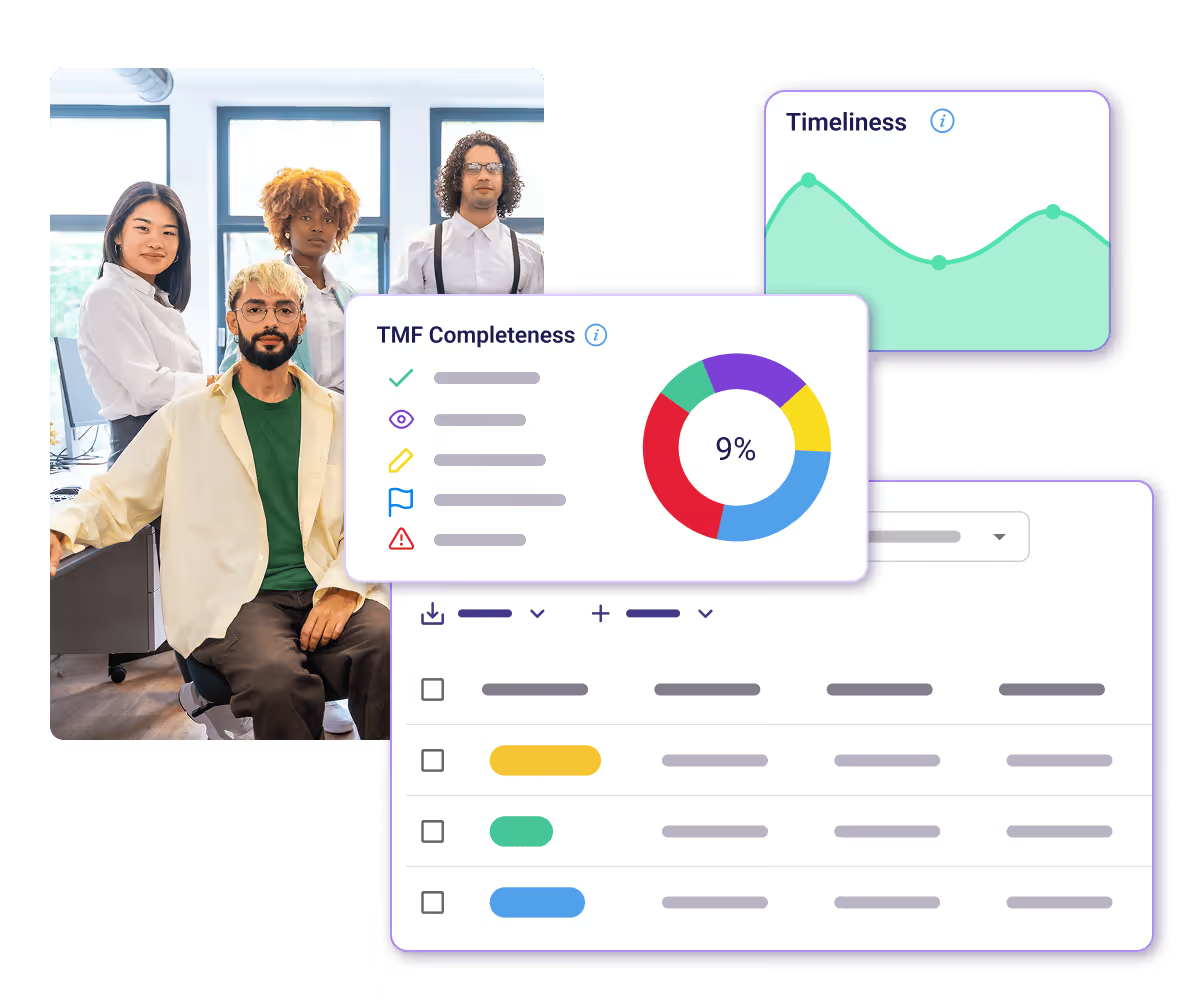
Electronic Trial Master File systems are becoming a standard tool for clinical trial teams, not a nice-to-have. The bar for what counts as a modern eTMF keeps rising. Risk-based oversight and real-time completeness tracking are no longer forward-looking ideas. Vendors deliver them today, and AI-assisted indexing is emerging as a differentiator worth evaluating closely as you compare systems. As you move to a new eTMF, plan for where the industry is heading, not only where it has been.
This guide gives you a starting point for your evaluation. Reach out to Montrium with questions as you move through the process.
Everyone's talking about AI in life sciences. But we have questions. How are clinical quality professionals actually using AI today? What are they skeptical about? What do they need to move forward? We surveyed professionals across the clinical research ecosystem: QA leaders, clinical operations professionals, regulatory experts, and consultants at CROs, sponsors, and sites, primarily in North America and Europe.
The goal: understand the real state of AI adoption in clinical quality work and identify what's holding teams back.